


-1200x900.jpg)
A dining table is the center of the home. This is where the whole family gathers in the morning and evening, holidays are celebrated, long conversations over coffee take place, and loved ones meet. That is why choosing a dining table should be approached carefully, taking into account the size of the room, the needs of the family, the material, shape, and style.
A wrong choice can cost both money and comfort: a table that is too large will block the passage, while one that is too small will not seat everyone comfortably at dinner. To make sure the table truly fits your home, it is important to understand the details before buying. Below is a structured guide to help you make the right decision. If you are already looking for ready-made models, take a look at MebWood solid wood tables.
Where to Start When Choosing a Dining Table
Before looking at specific models, it is worth honestly answering a few practical questions:
how many people sit at the table on an ordinary day;
how often guests come over;
where the table will stand — in the kitchen, living room, dining room, or studio apartment;
how much free space there is around it;
whether an extendable function is needed;
which material suits the existing interior;
whether it makes sense to order a table in a non-standard size.
These answers help avoid a common mistake: buying a beautiful table that turns out to be inconvenient in real life. People often choose furniture based on photos and only after installation notice that there is nowhere to place the chairs, no space to walk to the wall, or that six people sit at the table like sardines in a tin.
What Size Dining Table to Choose
Size is the main criterion, and no beauty of construction can replace it. Even the most expensive oak table will become a problem if it does not fit the room. The starting point is 55–60 cm per person along the length of the tabletop. If you want everyone to sit more freely, it is better to allow 65–70 cm.
Approximate dimensions for a rectangular table:
for 4 people — 120–140 cm;
for 6 people — 160–180 cm;
for 8 people — 200–220 cm;
for 10 people — 240–280 cm;
for 12 people — from 300 cm.
For a family or frequent dinners with friends, it is also worth reading a detailed article on the size of a dining table for 6 guests.
The optimal tabletop width is 80–100 cm. A narrower table will not allow dishes to be placed comfortably in the center, while a wider one will make conversation more difficult because of the large distance between people.
There should also be enough space around the table — at least 80–90 cm from the edge of the tabletop to the nearest wall or furniture. Otherwise, moving the chair back and getting up from the table will become a separate challenge.
If you need to calculate the length, width, and distance from the walls more accurately, use a separate guide on how to calculate the correct size of a dining table.
Rectangular, Round, or Oval: Which Shape to Choose
The shape is determined not by fashion, but by real conditions: room layout, number of people, and overall style.
A rectangular table is the most common option, and for good reason. It works equally well along a wall or in the center of the room, seats a large group, and fits into almost any space. For large families or those who regularly host guests, this is the most practical solution.
A round table creates a warm, intimate atmosphere. It is easy to communicate around it because everyone is equally close to one another. It works well in square rooms and small dining areas where you want to soften the corners. However, it requires free space around it, so it can be inconvenient in narrow rooms.
An oval table is something between the two previous options. It has no sharp corners, looks softer than a rectangular table, yet offers more seating capacity than a round table of a similar size. It works well in living rooms and dining rooms with enough space.
A square table is a solution for small groups and compact spaces. If the family is large or guests come often, this format quickly becomes too tight.
Do You Need an Extendable Table?
An extendable table makes sense when four people sit at it on weekdays and twice as many on weekends. In everyday use, it does not take up extra space, and when needed, it opens up to its full size.
Before buying, check:
dimensions in both positions — folded and extended;
type and convenience of the mechanism;
whether the table remains stable after extension;
where the insert section is stored when folded;
whether legs or supports interfere with guests’ legs;
how comfortable the table is for everyday use, not only during holidays.
For solid wood tables, the mechanism is especially important: an oak tabletop is heavy, and the extension system must be not only attractive, but truly reliable and durable.
Which Material Is Best?
The material affects not only the appearance, but also how long the table will last and how easily it can be restored after damage.
Solid oak is the first choice for a dining table if you need a durable and practical piece. Oak is resistant to loads, has a distinctive texture, and looks good in both classic and modern interiors. If needed, such a table can be sanded, refinished, or restored — and it will look like new again.
Beech is also a popular furniture material, but it has a different texture and behavior. It is suitable for certain products, but oak looks more substantial and solid, especially in premium interiors.
Walnut will appeal to those who want a dark table with an expressive grain. Its deep color and rich texture make walnut a true decorative accent.
MDF and chipboard cost less, but they do not provide the feeling of a natural material and do not withstand serious mechanical damage well. If the table is purchased for a few years, board materials may be justified. If you want a piece for the long term, solid wood is the better choice.
Which Supports to Choose
The supports define the appearance of the table and directly affect seating comfort.
Four classic legs are a proven solution. They are stable, familiar, and suitable for most rectangular and square tables.
A central support frees up legroom under the table and is often used in round and oval models.
Metal supports fit naturally into modern styles such as loft, industrial, and minimalism. They can be X-shaped, U-shaped, trapezoid-shaped, or have a custom design.
Wooden supports look warmer and more natural. They are an ideal option for Scandinavian, classic, or nature-inspired interiors.
When choosing supports, do not focus only on aesthetics: a striking massive base may turn out to be inconvenient if it prevents chairs from being placed properly or makes sitting uncomfortable.
Which Finish Is Better for a Dining Table?
A dining table comes into contact every day with plates, glasses, spilled coffee, hot dishes, and children’s hands. The finish must withstand all of this while still looking good.
For solid wood tables, lacquers, oils, stains, and matte or semi-matte protective systems are used. The choice depends on how you want the table to look after a year of daily use. A matte finish highlights the natural texture of the wood and looks modern and restrained.
Dark shades are visually impressive, but scratches and dust are easier to notice on them. Light tones make the space feel lighter and pair well with kitchens in neutral or natural color palettes.
How to Match a Table to the Interior
A table does not exist on its own. It should be in dialogue with the floor, facades, chairs, lighting, and the overall mood of the room.
For light, neutral interiors, warm or natural oak shades work well.
For loft interiors, a combination of an oak tabletop with metal supports, brushing, or an emphasized edge is a good choice.
For classic spaces, more substantial shapes, wooden supports, and restrained colors are suitable.
For minimalism, clean geometry, a thinner tabletop, and laconic supports work best.
If the room already has several strong accents, it is better to make the table more neutral. If the interior is simple and calm, the table itself can become the main element.
Ready-Made Table or Custom-Made Table?
A ready-made table is fast and clear. But standard sizes and a limited choice of colors do not always match a specific room or personal taste.
A custom-made table allows you to specify:
length and width;
tabletop shape;
type of wood;
tabletop thickness;
color and finish type;
support shape;
availability of an extension mechanism;
style for a specific interior.
This is especially relevant for non-standard rooms, large families, or simply for those who want not a “similar” table, but the exact right one.
Common Mistakes When Choosing a Dining Table
The most common mistakes to avoid:
judging a table only by photos, without considering room dimensions;
not leaving enough free space for passage;
choosing a table that is too small based only on the nominal number of seats;
not checking the height and compatibility with chairs;
not thinking through the mechanism and storage of the insert in an extendable table;
choosing a dark color without considering the lighting in the room;
ignoring the practicality of the finish in favor of appearance;
focusing only on price without understanding the material and construction.
To avoid most of these mistakes, it is enough to draw a simple room plan before ordering, place the table dimensions into it, and estimate how many people will sit at it on weekdays and on holidays.
Conclusion
A good dining table is not about trends, but about the balance between size, comfort, material, and appearance.
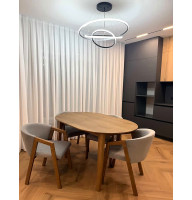
-192x200.JPG "Dining table Lutsk - with an extension for a large family and guests made of solid oak")
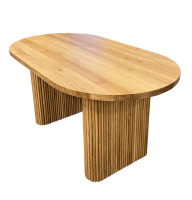
-192x200.JPG "Denwood is a folding dining table made of solid oak, designed for modern interiors of kitchens, studios, and living rooms.")


-400x300.jpeg)
-400x300.jpeg)
-400x300.jpeg)


Write a comment