


Hardness, moisture resistance, texture, price and practical choice for the home
When choosing between oak and beech furniture, it is important to compare more than just appearance and price. Both woods belong to high-quality hardwood species, but they behave differently in daily use, in contact with moisture, under load and during long-term operation.
Oak and beech are widely used in furniture production in Ukraine and Central Europe. Both materials are much more durable than softwoods or particleboard, but there are important differences between them. For a dining table, kitchen furniture, tabletop or furniture used every day, these differences have real practical value.
In this article, we explain how oak wood differs from beech wood, which material is better suited for furniture, when beech can be a reasonable choice and why MebWood most often works with solid oak.

Short Conclusion Before the Detailed Comparison
For furniture used actively every day, oak is usually the more practical choice. It is harder, better resists wear, has natural biological resistance and a more expressive appearance. This is especially important for dining tables, kitchen tables, tabletops, benches and furniture that regularly comes into contact with dishes, hands, moisture and mechanical load.
Beech is also a high-quality hardwood. Its advantages are a more uniform texture, a more accessible price and better bending ability after steaming. However, in conditions of increased humidity, intensive use or frequent cleaning, oak has a noticeable advantage.
Hardness and Mechanical Strength
European oak (Quercus robur) has a Brinell hardness of approximately 3.7–4.0 kN/mm² and a density of around 690–750 kg/m³.
European beech (Fagus sylvatica) has a hardness of approximately 3.2–3.5 kN/mm² and a density of around 680–720 kg/m³.
At first glance, the difference seems small — roughly 10–15%. But in real use it becomes noticeable: oak better resists minor scratches, dents, impacts and surface wear. That is why oak is often a more reliable choice for tables used daily for meals, work, serving and receiving guests.
Natural Moisture Resistance
Oak contains natural polyphenolic compounds — tannins. They improve the wood’s natural resistance to fungi, mold and insects. This is why oak has historically been used in structures designed for more demanding conditions: shipbuilding, bridges, wells and other long-lasting wooden constructions.
Beech is significantly less naturally moisture-resistant than oak. In dry residential rooms this is not always critical, but for a kitchen, dining area, bathroom, terrace or commercial space with frequent wet cleaning, oak is the safer solution.
It is important to understand that even oak furniture needs proper finishing and normal care. Natural moisture resistance does not mean that the product can be left in water or used without a protective surface coating.
Appearance and Texture
Oak has a pronounced pattern of annual rings, characteristic medullary rays, a warm golden-brown shade and a deep texture. Each board has its own natural appearance, so solid oak furniture never looks artificially identical.
Beech has a more uniform, fine texture without such a strong natural grain. Its color can vary from pinkish-white to warm beige, but overall the surface looks calmer and more homogeneous.
- Oak is better when furniture should become a visible accent in the interior.
- Beech works well where a smooth, neutral and calm surface is needed.
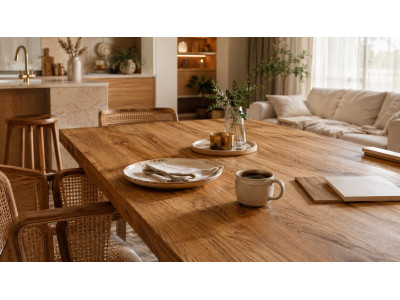
- For a solid dining table, oak usually looks more expressive and premium.
- For minimalist elements, beech can look more restrained.
Workability and Processing
Both woods can be machined and processed well, but they behave differently. Oak shows its strengths in solid straight furniture: tables, tabletops, benches, bases and pieces where structural stability is important.
Beech has one separate advantage — it bends well after steaming. This property made it a classic material for bentwood chairs, including the well-known Thonet style.
Price: Which Wood Is More Affordable
On average, solid beech in Ukraine can be about 10–20% more affordable than solid oak. This is connected with the availability of beech, especially in the Carpathian forests, and with its general positioning on the market.
However, the price of the finished product depends not only on the wood species. It is also influenced by the thickness of the parts, construction complexity, drying quality, finish type, hardware, manual work, sanding and quality control. Therefore, cheaper wood does not always mean a significantly cheaper finished table or furniture set.
Summary Table: Oak Wood vs Beech Wood
| Criterion | Oak wood | Beech wood | Practical conclusion |
|---|---|---|---|
| Hardness | High; better resists scratches and dents. | Also high, but slightly behind oak in daily use. | For active use, oak has the advantage. |
| Moisture resistance | Higher due to natural tannins. | Lower; more sensitive to moisture and microclimate. | For kitchens, terraces, dining areas or HoReCa, oak is better. |
| Resistance to fungi and insects | Higher natural biological resistance. | Requires more careful protection and a high-quality finish. | Oak is more reliable in demanding conditions. |
| Texture | Expressive, deep, with a natural grain pattern. | Even, uniform and calm. | Oak is for visual character; beech is for minimalism. |
| Curved forms | Less suitable for bending. | Bends well after steaming. | For bentwood chairs, beech has the advantage. |
| Price | Usually higher. | Often slightly more affordable. | In terms of budget, beech has an advantage. |
| Durability | Very high with proper drying, construction and care. | High in dry and stable indoor conditions. | Both woods can be durable, but oak is more universal. |
Where Oak Works Better and Where Beech Makes Sense
Oak is the optimal choice for solid dining tables, kitchen furniture, tabletops, benches, dining room furniture and pieces where resistance to wear, moisture and long-term load is important.
Beech is a good option for bentwood chairs, interior stairs and elements in dry rooms where a clean texture and a somewhat lower price are important.
- For an everyday dining table, oak is usually the more practical choice.
- For a kitchen table or tabletop, oak is better because of its higher resistance to load.
- For a cafe, restaurant or commercial interior, oak is more reliable due to its wear resistance.
- For bentwood chairs, beech can be the better technological choice.
- For dry interior elements, beech can be justified by budget and appearance.
What to Check Before Buying Oak or Beech Furniture
The wood species is important, but it is not the only criterion. A high-quality oak table and a poorly dried oak table are two different products. The same applies to beech: with the right technology it can last for many years, but it requires more attention to humidity and usage conditions.
- Wood moisture content — the material must be properly dried for indoor furniture.
- Type of finish — oil, hardwax oil and lacquer protect the surface in different ways.
- Product construction — part thickness, joint quality and base stability all matter.
- Usage scenario — a table for a kitchen, dining room, restaurant or family with children faces different loads.
If you need natural wood furniture for everyday use, expressive texture, high strength and long service life, oak will be the most universal choice. If you need a calm uniform texture, curved forms or a slightly more affordable solution for a dry room, beech can also be considered.
- We specialize in solid oak — this is a deliberate choice based on 30 years of experience.
- Oak is better suited for everyday load — it is strong, expressive and can be restored.
- Beech is not a bad material — it is suitable for specific tasks, especially curved forms and dry interiors.
- The key is the right usage scenario — furniture should match your conditions, not the other way around.
FAQ About Oak and Beech for Furniture
Which is better for furniture — oak or beech?
For furniture used actively every day, oak is usually the better choice. It is harder, more moisture-resistant, has a more expressive texture and better withstands intensive use.
Is beech worse than oak?
No, beech is not a bad wood. It is a high-quality hardwood that works well in dry rooms, curved forms and furniture with a calm uniform texture. However, oak has the advantage in moisture resistance and wear resistance.
Which wood is harder — oak or beech?
Oak has a Brinell hardness of approximately 3.7–4.0 kN/mm², while beech has about 3.2–3.5 kN/mm². The difference is not huge on paper, but it is noticeable in daily use.
What is better for a dining table?
For a dining table, oak is the more practical choice. It better withstands scratches, impacts, regular cleaning, contact with dishes and everyday family use.
Why is beech furniture often cheaper?
Solid beech in Ukraine is usually more affordable than solid oak. However, the final price of furniture also depends on construction, finish, hardware and production complexity.
-192x200.jpg "Dining table in the living room for the kitchen, oak folding on a Loftic metal support")

-192x200.jpg "Extendable YNWood table made of solid oak")


-400x300.jpeg)


Write a comment